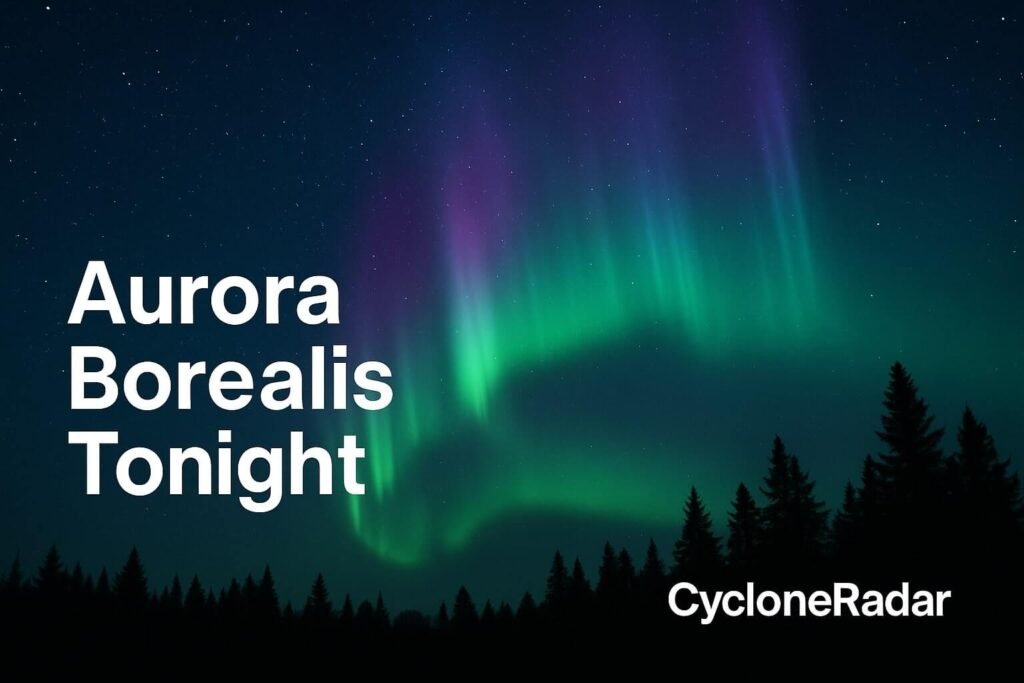

The sky has plans tonight, and if you live in the right place with clear weather and a bit of luck, you might just see them unfold in green and purple streaks. The northern lights tonight are not just a maybe. They’re a real possibility, with a G3 geomagnetic storm watch in effect from NOAA’s Space Weather Prediction Center for November 7, and a follow-up G2 watch into November 8. That means charged particles from the sun are actively stirring Earth’s magnetic field, setting the stage for auroras across the high latitudes, and potentially even into parts of the northern United States.
It’s one of those nights where nature rewards those who wait, those who step away from streetlights, and those who keep their eyes on the northern sky. If the conditions hold, you won’t need to go far north of the border to see the show.
Why Tonight Matters for Aurora Hunters
Here’s what’s happening behind the scenes. On November 5, the sun released multiple coronal mass ejections (CMEs), each carrying a load of solar particles that now race through space toward Earth. The first CME already hit, triggering the elevated geomagnetic activity forecast for tonight. NOAA responded by posting a G3 watch, meaning a strong geomagnetic storm is possible. A second CME is trailing behind, expected to arrive later and extend storm conditions into November 8 under a G2 rating, which still supports visible auroras in favorable regions.
This setup is significant because multiple CMEs interacting with Earth’s magnetic field can keep the aurora active for more than just a short spike. These aren’t one-and-done flashes. They come in waves, sometimes with hours between them. That’s why patience tonight could pay off.
When we talk about northern lights tonight, we’re talking about the kind of show that creeps slowly into view and then suddenly intensifies with vertical rays, flowing curtains, or even bursts of pink and violet. But location is key, and so is timing.
Where You Might See the Northern Lights Tonight
In the United States, the best viewing opportunities are concentrated along the northern tier. Based on NOAA’s updated aurora forecast maps, these states are the top contenders:
- Alaska: Almost a guaranteed sight if skies are clear
- Washington, Idaho, Montana: Very favorable, especially away from city lights
- North Dakota, South Dakota, Minnesota: Excellent odds with even a moderate geomagnetic storm
- Wisconsin, Michigan, Maine: Northern areas could see vibrant arcs or overhead displays
- Vermont, New Hampshire, northern New York: Faint glow possible, especially with a Kp surge
If you’re just south of this list, don’t give up. A strong enough storm (Kp index of 7 or more) can push the visible aurora farther down. That means states like Nebraska, Iowa, Illinois, Indiana, Ohio, and Pennsylvania might catch a glimpse of green low on the northern horizon if the timing and conditions align.
In Canada, most provinces above 50° latitude have excellent visibility potential tonight, from British Columbia through the Prairies to Ontario and Quebec. Northern parts of Europe, like Norway, Sweden, Finland, and Iceland, are also in the mix if skies remain clear and local light pollution is minimal.
If you’re in the Southern Hemisphere, you’re not left out entirely. Aurora australis is possible tonight as well, particularly in southern New Zealand and Tasmania, depending on how globally expansive this geomagnetic storm becomes.
Best Time to Look and What to Watch For
The most active period for the aurora generally falls between 10 p.m. and 2 a.m. local time, centered around what scientists call magnetic midnight. That’s when Earth’s orientation lines up best for solar energy to flow into our atmosphere. But substorms can flare earlier in the evening or persist closer to dawn, especially with strong and sustained solar wind.
What should you actually do to catch the northern lights tonight?
- Head away from cities. Light pollution is the aurora’s worst enemy.
- Face north. Unless you’re in the high Arctic, the glow will typically arc in the northern sky.
- Stay patient. Auroras often come in pulses. You might see nothing for 45 minutes, then five minutes of magic.
- Bring your camera. Phones with night mode can detect green light your eyes might miss.
NOAA’s 30-minute Aurora Forecast map is one of the most useful tools tonight. It shows real-time oval activity and can help you judge if the aurora is pushing south enough for your area. Combine that with the K-index. A value of Kp 6 suggests moderate storming. Kp 7 or higher often means strong storming and a better chance of seeing auroras farther from the poles.
At the time of writing, data from NOAA’s Enthusiasts Dashboard shows enhanced solar wind speed and a southward-oriented magnetic field (Bz negative), which means conditions are ripe. If the solar wind holds or intensifies again after the second CME arrival, we could see another surge in aurora activity late tonight or even into early morning hours tomorrow.
It’s the Sky’s Turn to Glow
Skywatchers live for nights like this. While forecasts always come with a dose of uncertainty, everything is in place for an aurora event visible to millions if clouds stay away. That rare mix of solar energy, timing, and magnetospheric alignment is swirling above us now.
Whether you’re in northern Montana or rural Michigan, on the shores of Lake Superior or a dark prairie in North Dakota, your best move tonight is simple: look up.
If you’re lucky, the northern lights tonight won’t just be a forecast, but a living, glowing ribbon across your sky.

